Archive for November, 2026

Local SEO Checklist 2026: 10 Steps to Rank Higher in Google Maps

November 8th, 2026 | SEO 8th, November at 12:30 PM

When someone searches “near me” or adds a city to their search, Google shows a map pack of local businesses before the regular results. If your business isn’t in that pack, you’re missing customers who are ready to buy. This local SEO checklist walks you through the 10 steps that matter most in 2026, from your Google Business Profile to reviews, local pages and tracking.
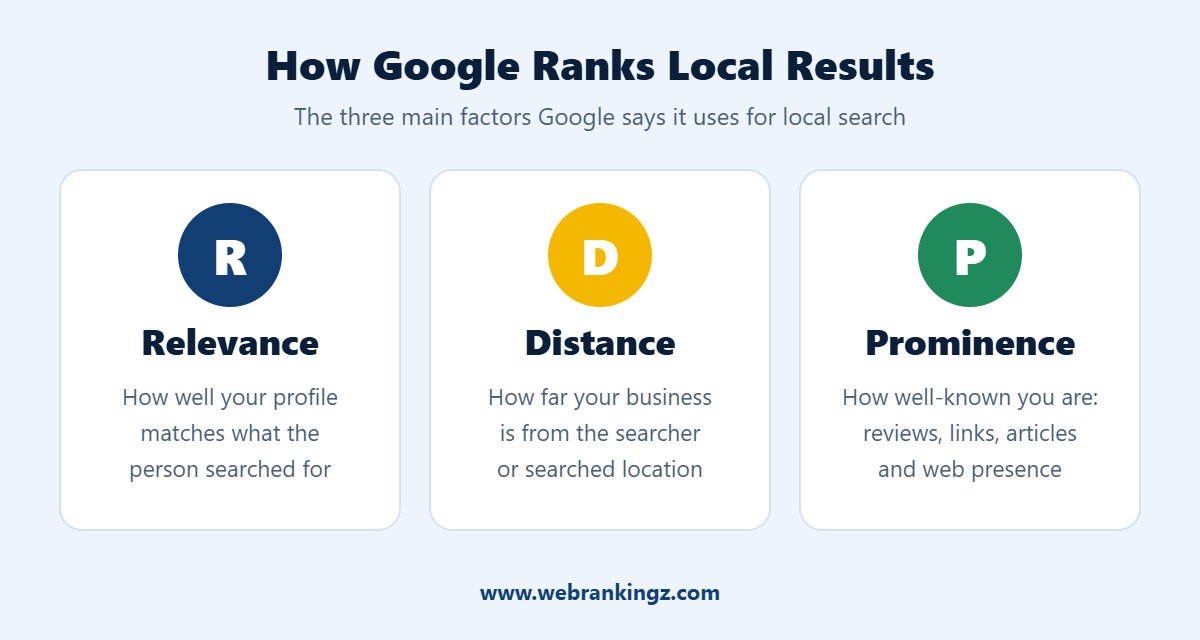
Google local ranking factors: relevance, distance and prominence
Google’s three main local ranking factors

How Google Ranks Local Businesses

Google explains that local results are based mainly on three factors (source: Google Business Profile Help):

  • Relevance: how well your profile matches what the person searched for.
  • Distance: how far your business is from the searcher or the location in their search.
  • Prominence: how well-known your business is, based on reviews, links, articles and your wider web presence.

You can’t change your distance from a searcher, but you can improve relevance and prominence. That’s exactly what the checklist below is for.

The 10-Step Local SEO Checklist for 2026
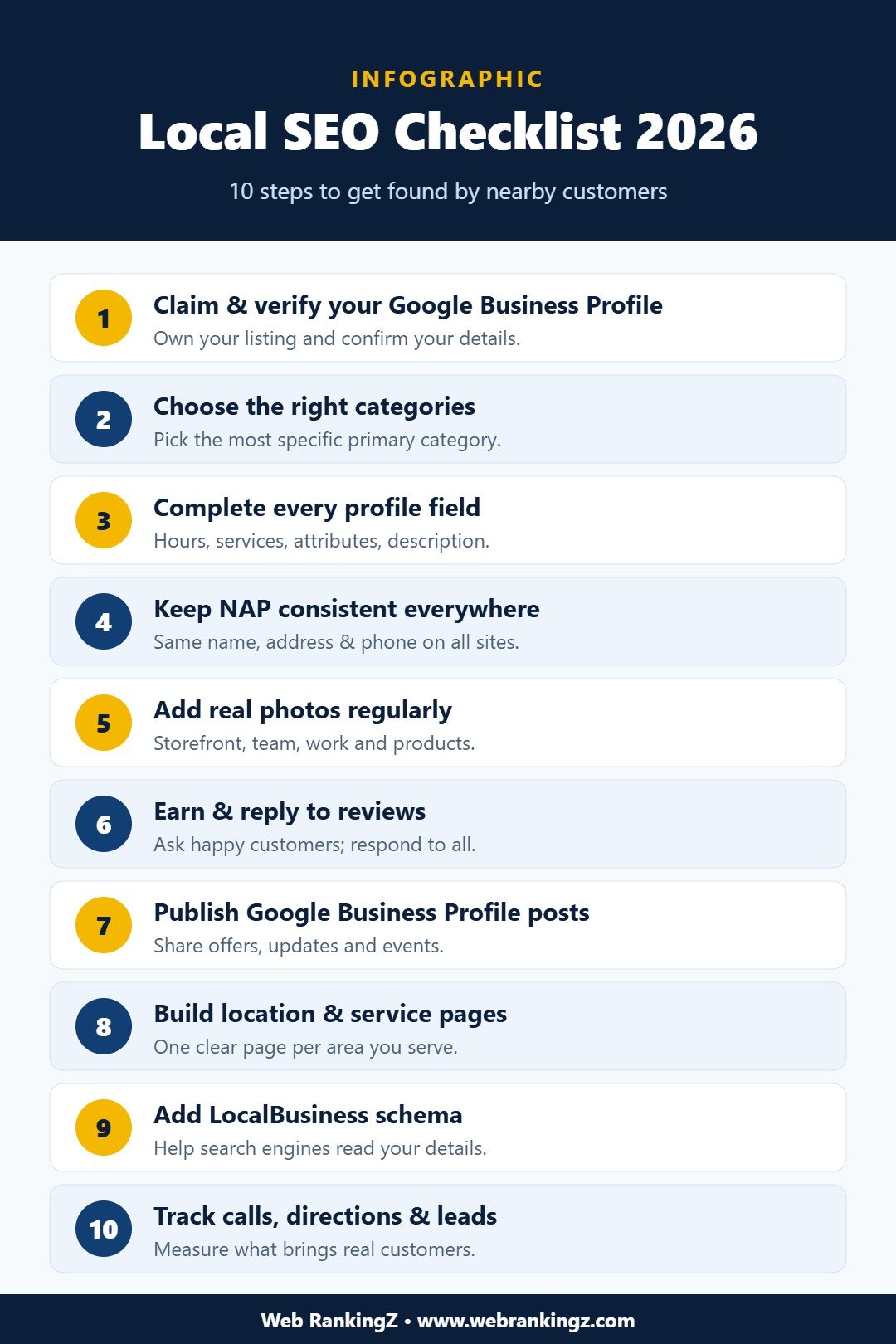
Local SEO checklist infographic showing 10 steps from claiming your Google Business Profile to tracking leads
Infographic: the 10-step local SEO checklist

1. Claim and Verify Your Google Business Profile

Your Google Business Profile is the foundation of local SEO. Claim it, complete verification, and make sure only trusted people on your team have access. An unverified or unclaimed profile can be edited by others and won’t perform well.

2. Choose the Right Categories

Your primary category has a big influence on which searches you appear for. Choose the most specific option that describes your main service (for example, “Internet marketing service” rather than a generic category), then add a few relevant secondary categories.

3. Complete Every Profile Field

Fill in your business description, opening hours, holiday hours, services, products, service areas and attributes. A complete profile gives Google more information to match you with relevant searches and gives customers confidence to contact you.

4. Keep Your NAP Consistent Everywhere

NAP stands for Name, Address and Phone number. Use exactly the same details on your website, Google Business Profile, social media and directories. Inconsistent details confuse both search engines and customers.

5. Add Real Photos Regularly

Upload genuine photos of your storefront, team, work and products. Avoid generic stock images. Fresh, authentic photos make your listing more engaging and show that your business is active.

6. Earn and Reply to Reviews

Reviews are one of the strongest signals of prominence and trust. Ask satisfied customers for a review after a job well done, make it easy with a direct review link, and respond to every review, positive or negative, in a professional and helpful way. Never buy or fake reviews; it breaks Google’s policies and can get your profile suspended.

7. Publish Google Business Profile Posts

Use posts to share offers, events, new services and updates. Posts keep your profile fresh and give searchers another reason to choose you.

8. Build Location and Service Pages on Your Website

Create a dedicated, useful page for each main service and each area you serve. Include local details, real examples, FAQs and a clear call to action. Avoid thin pages that only swap the city name; Google rewards helpful, original content.

9. Add LocalBusiness Schema Markup

Structured data such as LocalBusiness and Organization schema helps search engines understand your business name, address, hours and contact details. SEO plugins like Rank Math make this easy to set up on WordPress.

10. Track Calls, Direction Requests and Leads

Use your Google Business Profile performance report and Google Analytics 4 to track calls, website clicks, direction requests and form submissions. Add UTM tags to your profile’s website link so you can see exactly how many visitors and leads come from your listing.

Local SEO and AI Search

AI Overviews and AI assistants increasingly answer local questions by drawing on business listings, reviews and trusted websites. The same steps in this checklist (accurate profiles, strong reviews and helpful local pages) also improve your chances of being recommended in AI-powered results. Learn more in our guide to getting your business cited in AI search.

Common Local SEO Mistakes to Avoid

  • Using different business names or phone numbers across websites
  • Adding keywords or city names to your business name on Google
  • Ignoring negative reviews instead of responding
  • Creating near-identical location pages
  • Setting up your profile once and never updating it

Frequently Asked Questions

How long does local SEO take to show results?

Quick fixes such as completing your profile can make a difference within weeks, while building reviews, citations and local content is an ongoing process that typically shows stronger results over several months.

Do I need a physical address for local SEO?

No. Service-area businesses that visit customers can hide their address on Google Business Profile and list the areas they serve instead.

Is local SEO only for small businesses?

No. Any business that serves customers in specific locations, from a single shop to a multi-location brand, benefits from local SEO.

Get Help with Local SEO

Following this local SEO checklist will put your business in a much stronger position to appear in Google Maps and local search. If you’d like an expert team to handle it for you, explore our Local SEO services and SEO services, or request a free quote today.

AI Search in 2026: How to Get Your Business Cited in Google AI Overviews and ChatGPT

November 8th, 2026 | SEO 8th, November at 10:08 AM

Search has changed more in the last two years than in the decade before it. Your customers still use Google, but many now get their answer from an AI Overview at the top of the results, or ask ChatGPT, Gemini or Perplexity directly. These tools often answer without the user ever clicking a link.

For businesses, the question is no longer only “how do we rank #1?” but also “how do we get mentioned in the AI answer?” This practice is often called Generative Engine Optimization (GEO), or AI search optimization. Here’s what it means and how to prepare for it.

What Is Generative Engine Optimization (GEO)?

GEO is the process of making your content easy for AI systems to find, understand, trust and cite. Traditional SEO focuses on ranking a page in a list of links. GEO focuses on being one of the sources an AI tool pulls from when it writes its answer, and ideally the brand it names or links to.

The good news: GEO is built on strong SEO. Search engines and AI assistants still rely on crawlable, well-structured, trustworthy websites. Your SEO work isn’t wasted; it’s the foundation.

Why It Matters for Your Business

  • Fewer clicks for simple questions: When an AI answer fully covers a basic query, fewer people scroll down to the organic results.
  • Citations build trust: Being named as a source in an AI answer puts your brand in front of buyers at the moment they’re researching.
  • Higher-intent visitors: People who click through from an AI answer usually want more depth: pricing, a quote, or a conversation with an expert.

7 Practical Ways to Get Your Business Cited in AI Search

1. Answer Real Questions Directly

Structure pages around the questions your customers actually ask. Put a clear, two-to-three sentence answer right under each heading, then expand with detail. AI systems favour content that gets to the point.

2. Show Real Expertise (E-E-A-T)

Google’s focus on Experience, Expertise, Authoritativeness and Trustworthiness matters even more in AI search. Add author names and bios, share first-hand results and case studies, and cite reliable sources. Original insights are far more likely to be quoted than generic content.

3. Use Structured Data (Schema Markup)

Schema markup such as Organization, LocalBusiness, FAQ, Article and Service tells machines exactly what your content is about. It doesn’t guarantee a citation, but it removes guesswork for search engines and AI crawlers.

4. Make Content Easy to Extract

Use descriptive headings, short paragraphs, bullet lists, comparison tables and step-by-step instructions. Content that’s easy for a person to skim is also easy for an AI to summarise accurately.

5. Keep Your Technical SEO Healthy

If crawlers can’t access or render your pages, they can’t cite them. Check your robots.txt and XML sitemap, fix broken links, improve page speed and Core Web Vitals, and make sure important content isn’t hidden behind scripts.

6. Build Your Brand Beyond Your Website

AI tools learn about brands from across the web. Consistent business listings, a well-maintained Google Business Profile, genuine customer reviews, industry directories and mentions in trusted publications all strengthen how AI systems understand your business.

7. Keep Content Fresh

Outdated pages lose trust. Review your key service pages and guides regularly, update facts and examples, and show a visible “last updated” date where it makes sense.

Don’t Forget Local Search

For local businesses, AI-powered results often blend with map listings and reviews. Keep your name, address and phone number consistent everywhere, respond to reviews, and create location-specific pages that clearly describe your services in each area you serve.

How to Measure Success

Rankings alone no longer tell the full story. Alongside organic traffic and keyword positions, track:

  • Branded search volume and direct traffic
  • Referral traffic from AI tools such as ChatGPT, Perplexity and Gemini (visible in Google Analytics 4)
  • Whether your brand appears when you ask AI assistants questions about your services
  • Leads and conversions, not just visits

Quick GEO Checklist

  • Clear answers under question-based headings
  • Author bios and real examples on key content
  • Schema markup on important pages
  • Fast, crawlable, mobile-friendly website
  • Consistent listings and active review management
  • Regular content updates

Get Ready for AI Search with Web RankingZ

AI search rewards businesses that combine solid technical SEO, helpful content and a trusted brand presence. Our team helps businesses audit their websites, strengthen content and stay visible across Google and AI-powered search.

Request a free quote or explore our SEO services to get started.